Alaska Cruise Camera Gear: What to Pack for Wildlife and Scenery
The most useful camera kit for an Alaska cruise combines a versatile everyday lens, a telephoto for distant wildlife, and protection from rain and spray. For many travelers, one camera body with two lenses is enough.
Your equipment should match the photographs you want to bring home. Glaciers and coastal towns call for different tools than distant eagles or whales. A larger kit gives you more options, but it also adds weight on excursions and makes equipment changes more complicated.
Here’s how to choose an Alaska cruise photography kit you’ll actually enjoy carrying.
Which lenses should you bring on an Alaska cruise?
The focal lengths below refer to full-frame cameras or their equivalent field of view. Smaller-sensor cameras can provide similar framing with shorter actual focal lengths.
24–70mm or a similar standard zoom: Useful for coastlines, towns, shipboard scenes, and environmental portraits. Its main limitation is distant wildlife.
70–200mm telephoto zoom: Useful for mountain details, closer wildlife, and compressed landscapes. Small or distant animals may still be too far away.
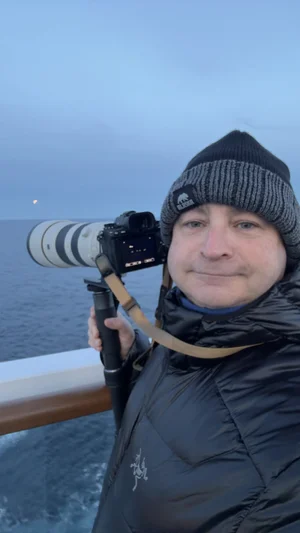
100–400mm or a similar telephoto zoom: A flexible balance of wildlife reach and portability, with more size and weight than an everyday lens.
200–600mm supertelephoto zoom: Useful when distant birds and wildlife are a major priority. Expect substantial size and weight.
A standard zoom and a telephoto reaching around 400mm make a practical combination for travelers who want both scenery and wildlife.
A 200–600mm lens becomes more appealing when wildlife photography is a central purpose of the trip. Before packing one, practice carrying it and tracking moving subjects. Reach helps, but equipment you struggle to hold steady may deliver fewer usable photographs than a lighter setup.
Telephoto lenses also magnify the effects of camera movement, making careful technique and suitable shutter speeds particularly important.
Can you photograph an Alaska cruise with a phone?
Absolutely. A phone is useful for broad landscapes, meals, port visits, and everyday moments onboard.
Its biggest limitation is distant wildlife. Heavy digital zoom crops and enlarges the image, which can leave small subjects without much detail.
Use your phone when it fits the scene. For distant animals, a camera with a suitable telephoto lens offers more flexibility. Neither option guarantees a close-up: wildlife may remain too far away for a strong photograph.
Starting camera settings for Alaska wildlife
These settings are suggestions to adjust for light, subject movement, focal length, and the motion of the vessel.
Scenery from a moving vessel: Start around 1/500 second. Use a moderate aperture when the light allows.
A relatively still animal: Start around 1/500–1/1000 second. Use continuous autofocus and focus on the eye.
Surfacing whales or active wildlife: Start around 1/1000–1/1600 second. Use short bursts and continuous autofocus.
Birds in flight: Start around 1/2000 second or faster. Use tracking autofocus and leave room in the frame to follow the bird.
Auto ISO can help maintain your selected shutter speed as the light changes. Review images at high magnification: if the subject is blurred, increase the shutter speed before assuming that autofocus is the problem.
Image stabilization helps reduce camera shake. It does not freeze a moving animal. Faster shutter speeds are an important tool for controlling subject motion.
Protect your camera from rain and spray
Keep weather protection accessible rather than buried beneath the rest of your gear.
Pack:
A rain cover that fits the camera with its longest lens attached.
A protective bag or dry bag for transport.
Several clean microfiber cloths.
A lens hood to help shield the front element.
Spare batteries and memory cards in a dry pouch.
Weather-resistant equipment is not necessarily waterproof. Follow the manufacturer’s limits and avoid unnecessary exposure to saltwater spray.
Change lenses in a sheltered location. If spray reaches your equipment, follow its cleaning instructions; don’t grind dried salt or grit into the glass with a cloth.
Should you bring a tripod?
A tripod can be useful for deliberate photography on land, such as a waterfall or a stationary low-light scene.
On a moving boat, it cannot cancel the vessel’s movement and may transmit vibration. It can also obstruct walkways and other passengers.
For most shipboard wildlife photography, handheld shooting with a suitable shutter speed is more practical. Check excursion rules before bringing a tripod or monopod.
Photograph wildlife without moving closer
A longer lens is a way to work from a respectful distance, not a reason to push beyond a viewing boundary.
Follow your guide’s instructions and the rules of the location you are visiting. For example, Kenai Fjords National Park instructs visitors to remain 300 yards from bears and at least 25 yards from other animals, dens, and nests. Those are location-specific instructions, not a universal rule for every Alaska activity.
On wildlife cruises, let the operator manage the vessel’s position. Sometimes the responsible photograph is a wider image showing the animal within its surroundings.
A practical Alaska cruise photography checklist
For a balanced kit, bring one camera body, a standard zoom, a telephoto, spare batteries, memory cards, rain protection, and a comfortable strap.
Add a second body if avoiding lens changes matters to you. Add a longer lens if wildlife is a priority. Bring a tripod only when you have a specific use for it.
Back up photographs during the trip, and keep a second copy separate from the camera whenever possible.
Frequently asked questions
Is a 70–200mm lens enough for Alaska?
It can work well for landscapes and closer wildlife. For distant birds or animals viewed from a ship, more reach is often useful.
Do you need an expensive camera?
No. Familiar controls, a suitable lens, and good technique matter more than buying equipment immediately before departure.
Should you photograph everything at maximum zoom?
No. Start wide enough to find and follow the subject, then tighten the composition. Include some wider photographs that show the coastline, mountains, or surrounding water.
The strongest Alaska photo collection usually includes both the wildlife and the place it lives.